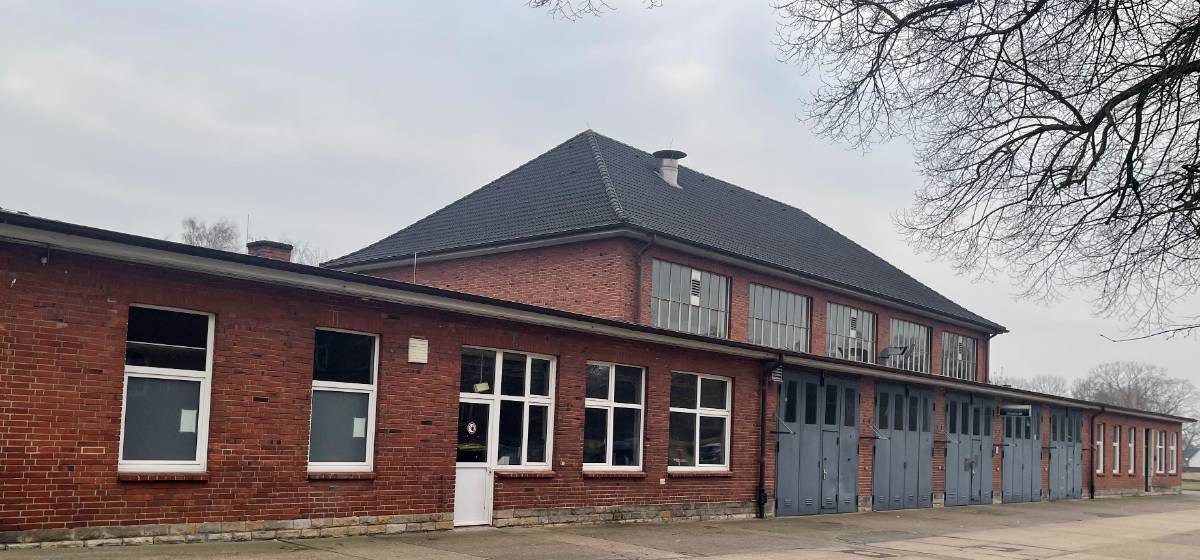
The OceanLab building — a repurposed 1930s military workshop in Bremen-Nord
Marine Technology & Research · Est. 2001

Exploring & protecting
the ocean frontier

For over two decades OceanLab has combined ultra-trace marine geochemistry with internet-operated deep-sea crawlers and long-duration seafloor monitoring — building the tools that reach the ocean floor, from Barkley Canyon methane seeps to the metal-rich nodule fields of the Clarion–Clipperton Zone.

2001
Founded
90+
Publications
30+
Expeditions
18
Int'l projects
01 — About OceanLab

Two decades of deep-sea innovation

OceanLab was founded in 2001 as a geoscience research group at the newly established International University Bremen — later Jacobs University, now Constructor University. From the start it grew as a joint effort: Prof. Laurenz Thomsen built the marine engineering and crawler-robotics side, while Prof. Andrea Koschinsky — a veteran of numerous international research cruises — and Prof. Michael Bau established the geochemistry laboratory a year later. Together, the two sides evolved into a multidisciplinary marine technology and geochemistry centre, unique among German university labs.

The lab occupies a remarkable piece of industrial history: a former 1930s military tank workshop (Panzerwerkstatt) in Bremen-Nord, whose reinforced floors and wide-bay garage doors proved ideal for handling multi-tonne marine equipment and operating a large indoor test basin. The building's adjoining former Klempner (plumber's) workshop became the geochemistry laboratory — and over more than two decades, the two sides of the building have been equally central to OceanLab's success.

Over 21 years the team led more than 30 expeditions, coordinated 18 international programmes (BMBF, DFG, EU, industry), and authored over 90 peer-reviewed papers. Prof. Vikram Unnithan has long supported the lab with marine geophysics, and Prof. Francesco Maurelli joined in 2018 to lead marine robotics. Following Thomsen's move to Gothenburg in 2022, this broader team continues the work — combining marine geosciences, robotics, sensor development, and analytical geochemistry.
Timeline
2001
OceanLab founded by Prof. Thomsen in the building's former tank-workshop bay, converted into an indoor test basin, mechanical workshop, and electronics lab. Initial focus: benthic boundary-layer dynamics and deep-sea particle transport.
2002
Geochemistry laboratory established in the building's former Klempner (plumber's) workshop bay by Prof. Andrea Koschinsky and Prof. Michael Bau, adding ultra-trace analytical capability alongside OceanLab's marine engineering side.
2007
Wally crawler developed — one of the world's first internet-controlled deep-sea benthic crawlers, remotely operated from Bremen. Later commercialised through the iSeaMC spin-off.
2009–2016
Wally deployed at Barkley Canyon, 870 m, with Ocean Networks Canada. Operated continuously for ~7 years, delivering live seafloor data including methane-seep observations. A DFKI laser scanner was integrated in 2016 for millimetre mapping.
2013
ROBEX Helmholtz Alliance: OceanLab leads the deep-sea crawler design team. iWally deployed with methane flux sensor, stereo cameras, and a novel floating-tether locomotion system bridging space and deep-sea robotics.
2018
Prof. Francesco Maurelli joins OceanLab, establishing the marine robotics & autonomous systems programme and expanding the lab's AUV capabilities.
2020
OceanLab contributes to a landmark Nature Ecology & Evolution paper co-authored by 100+ deep-sea scientists, defining key parameters for deep-sea protection in the context of future seabed mining.
2022
Prof. Thomsen moves to the University of Gothenburg; the university is renamed Constructor University. OceanLab's engineering and geochemistry sides continue under Profs. Koschinsky, Bau, Maurelli, and Unnithan.
2026
MARFAB — an €800k proposal for Germany's integrative hub for sustainable deep-sea resource technology. Initial BMBF InfraBoost submission unsuccessful; resubmission in preparation.
Inside the lab
OceanLab building exterior
A repurposed 1930s military workshop, converted into a marine research facility in 2001.
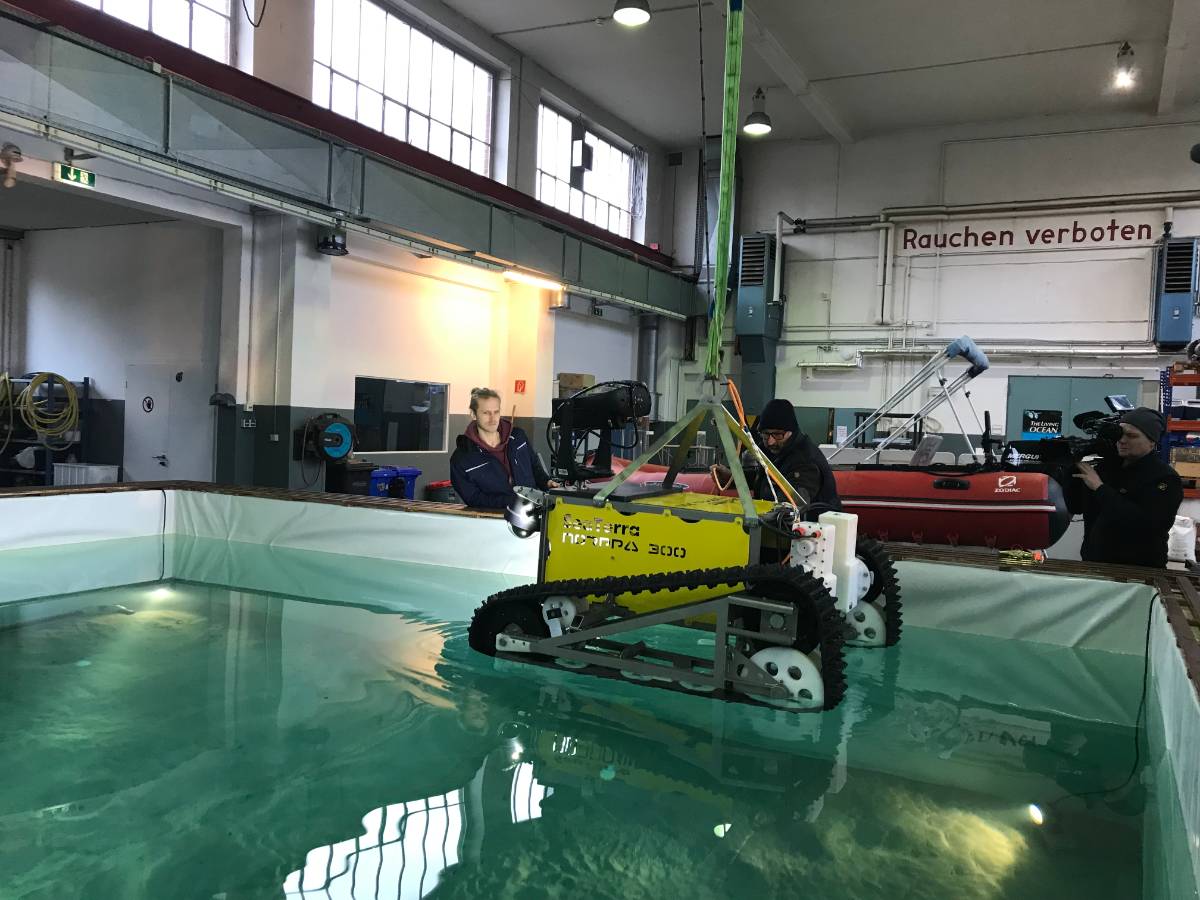
SeaTerra NOMRA 300 crawler in the test basin
The SeaTerra NOMRA 300 tracked crawler lowered into the indoor test basin during pre-deployment validation — a facility unique among German universities.
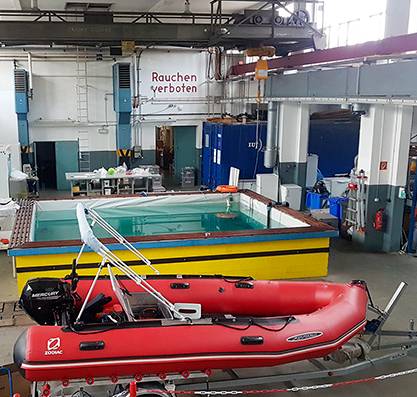
OceanLab interior — indoor test basin and research vessel
Inside the workshop: the indoor test basin and inflatable research vessel, housed in the original industrial hall.
90+
Peer-reviewed papers
30+
Research expeditions
18
International projects
7 yrs
Continuous seafloor deployment
02 — Infrastructure

World-class facilities under one roof

Large-scale wet engineering infrastructure, precision fabrication, and high-end analytical chemistry — all co-located on the Constructor University campus. No other academic lab in northwestern Germany offers this combination of test infrastructure and precision capability under one roof.

Wet Infrastructure

Large indoor test basin

Full-scale underwater equipment testing and deployment simulation. Supports ROV and crawler trials, AUV integration, and instrument validation under realistic submersion — a unique regional asset also used for media productions.

Fabrication

Constructor Toolshop — workshop

A fully equipped fabrication and prototyping shop: CNC router, lathe, TIG welder, band saws, drill presses, and a resin-curing oven. Operated by mechatronic engineer Martin Messmann. Full tool list →

Electronics

Constructor Toolshop — electronics lab

Sensor integration, PCB work, and embedded prototyping for deep-sea deployment. Oscilloscope, function generator, soldering station, microscope, CAN-bus and network analysers — full in-house development of IOV and crawler electronics.

Analytical

Geochemistry laboratory

Ultra-trace metal analysis: ICP-MS (NexION 350X) with SeaFAST pre-concentration, ICP-OES, voltammetry, ion chromatography, TOC/DOC, and high-pressure digestion in metal-free clean-lab space. Instrument list →

Planned · MARFAB

Fabrication & high-pressure suite

Proposed: titanium-rated CNC, waterjet, laser welding, multi-technology 3D printing, precision metrology, plus a deep-sea chamber simulating 4,000–6,000 m pressure — closing the lab-to-deployment gap. Resubmission in preparation.

03 — Science

Research areas

Spanning deep-sea ecology, benthic geochemistry, autonomous robotics, and marine technology development — with a growing focus on sustainable critical-metal resource assessment at the intersection of environmental science and industrial responsibility.

Deep-sea monitoring & benthic ecology

Long-duration in-situ monitoring using tethered and autonomous crawlers. Benthic boundary-layer dynamics, organic carbon flux through submarine canyons, and methane-seep communities. Barkley Canyon (870 m, ONC) delivered seven years of continuous live seafloor data.

Marine robotics & autonomous systems

Led today by Prof. Francesco Maurelli: intelligent crawler platforms (Wally, iWally, TRAMPER) and cooperative AUVs within EU FP7 Co3-AUVs and ROBEX. Track-based locomotion, floating-tether systems, autonomous photogrammetric mapping, and internet-operated vehicle architectures. Current work extends into persistent autonomy and visual-sonar underwater localisation. Commercialised via iSeaMC.

Critical metal geochemistry

Ultra-trace analysis of rare earths, cobalt, nickel and copper in marine mineral resources — polymetallic nodules (Clarion–Clipperton), massive sulfides, and cobalt-rich crusts. Trace-metal speciation and biogeochemical cycling by ICP-MS, ICP-OES, and voltammetry.

Deep-sea mining environmental assessment

Baseline characterisation, sediment-plume modelling, and monitoring-tool development for responsible extraction and ISA compliance. Contributor to the 2020 Nature Ecology & Evolution paper on deep-sea protection. Cooperation with MARUM, AWI, GEOMAR.

Marine sensor technology & in-situ instrumentation

Development and field validation of in-situ sensors for methane flux, particle-size distribution, and trace metals. Drill-cutting and cold-water-coral impact monitoring for the Norwegian offshore industry, with real-time wireless uplink from seabed to shore.

Blue biotechnology & marine climate solutions

Microalgae research for CO₂ sequestration, wastewater treatment, and energy. With Phytolutions GmbH, installed the first outdoor microalgae pilot plant in Weihai, China.

04 — Technology

Platforms & systems

From internet-operated benthic crawlers to cooperative AUV fleets and integrated survey suites, OceanLab develops and operates a distinctive range of marine platforms for scientific exploration and technology validation.

Seafloor Crawler · IOV

Wally / iWally / TRAMPER

Tethered benthic platforms for long-duration seafloor monitoring. Wally was among the world's first internet-operated deep-sea crawlers, running ~7 years at Barkley Canyon (870 m) via Ocean Networks Canada, controlled in real time from Bremen.

  • ▸Continuous 7-year deployment, 2009–2016
  • ▸Real-time remote control, Bremen → Canada
  • ▸Methane sensor, stereo camera, laser scanner
  • ▸Novel floating-tether locomotion
Autonomous Underwater Vehicle

AUV Fleet & Co3-AUVs

A generation of sensor-rich AUVs for cooperative underwater missions, tested in the OceanLab basin and open water. EU FP7 Co3-AUVs (2010–2014) established cooperative cognitive control for multi-vehicle survey coordination. Prof. Francesco Maurelli's group continues this line with research on underwater visual registration, sensor fusion, and localisation for the next generation of AUVs.

  • ▸Multi-modal payload: sonar, cameras, chemistry
  • ▸Cooperative multi-vehicle survey control
  • ▸EvoLogics acoustic-modem integration
  • ▸International summer school hosted, 2010
Environmental Monitoring

In-situ monitoring platforms

Integrated real-time observation systems for demanding marine settings. A 2014 project deployed submarine sensor platforms off Norway with wireless uplink to shore, monitoring drilling impacts on cold-water-coral ecosystems.

  • ▸Real-time wireless uplink, seabed → shore
  • ▸With Norwegian Institute of Marine Research
  • ▸LISST particle analyser, plume characterisation
  • ▸Marine Pollution Bulletin, 2014
Resubmission in Preparation

MARFAB

Marine FabLab for Sustainable Deep-Sea Resource Technologies — integrated infrastructure for environmental monitoring and mineral assessment.

An €800,000 infrastructure proposal closing the gap between laboratory-scale development and validated deep-sea deployment — adding high-pressure testing (to 6,000 m equivalent), QqQ-ICP-MS ultra-trace geochemistry, and integrated multi-sensor geophysics.

An initial submission to the BMBF InfraBoost programme was not successful. The team is preparing a strengthened resubmission.

PI: Prof. Koschinsky · Co-I: Prof. Bau · Co-I: Prof. Unnithan

Three infrastructure pillars

Germany's premier deep-sea technology hub

01

Deep-sea mining technology testing & validation

High-pressure simulation chamber (4,000–6,000 m), AI-driven selective-harvesting robotics platform, and an advanced fabrication workshop (CNC, waterjet, 3D printing, laser welding, metrology). ≈ 30% of budget

02

Advanced marine geochemical monitoring lab

Triple-quadrupole ICP-MS for interference-free ultra-trace analysis (<0.01 ppt), laser ablation (<10 µm), online pre-concentration, and field-deployable electrochemical sensor calibration. ≈ 50% of budget

03

Marine geophysics, data fusion & monitoring

Marine magnetics, hyperspectral imaging, acoustics, USBL positioning, plus an HPC/AI platform for multi-sensor data fusion and real-time decision support. ≈ 20% of budget

All components install in existing facilities — no construction required. Designed as open-access shared infrastructure for academic groups, start-ups, SMEs, and industry.

05 — Analytical Infrastructure

Geochemistry laboratory

Led by Prof. Dr. Andrea Koschinsky together with Prof. Dr. Michael Bau, a fully equipped trace and ultra-trace analytical facility co-located with OceanLab. It specialises in metals, metalloids, and organic matter in seawater, sediments, pore waters, and marine mineral resources.

Capabilities span the full workflow — from clean-lab sample preparation through automated pre-concentration (SeaFAST S2) to multi-element and speciation analysis by ICP-MS, ICP-OES, and voltammetry. This directly supports deep-sea monitoring, critical-metal characterisation, and MARFAB goals.

The lab contributes to GEOTRACES, JPI Oceans MiningImpact, and collaborations with MARUM, AWI, and GEOMAR.

Full equipment page →
Elemental Analysis
ICP-MS — PerkinElmer NexION 350X

Ultra-trace multi-element analysis; coupled with APEX interface and ESI.

ICP-OES — Spectro Ciros Vision

Simultaneous multi-element determination in complex marine matrices.

Pre-concentration & Introduction
SeaFAST S2 (ESI)

Automated online trace-metal enrichment from seawater; sub-ppt limits in high-salinity matrices.

Electrochemistry & Voltammetry
Metrohm 797 VA Computrace · Autolab PGSTAT204

Trace-metal speciation, sensor development, and automated high-throughput voltammetric analysis.

Ion, Organic & Sample Prep
IC · TOC/DOC · UV Digester · Pico Trace HP Digestion

Ion chromatography, organic-carbon analysis, photochemical destruction, and high-pressure acid digestion — all in metal-free clean workspaces.

06 — Workshop & Fabrication

Constructor Toolshop

OceanLab's in-house fabrication and prototyping facility — open to students, scientific staff, and research projects. Manufacturing services, hands-on training, and expert consultation, all under one roof in Ocean Lab / 15.

Martin Messmann

Mechatronic Engineer · Marine Systems & ROV Specialist
LOCOcean Lab / 15 · Campus Ring 1, 28759 Bremen
Opening Hours — By Appointment

Tue–Wed 10:00–17:00
Thu–Fri 09:30–12:30
Emergency visits and interesting projects always welcome.

What we offer
  • ▸Manufacturing of components or complete experimental set-ups to specification
  • ▸Repair of broken machines, instruments, and components
  • ▸3D CAD components and assemblies; production drawings
  • ▸Consulting on mechanical and manufacturing questions
  • ▸Electronic circuit & PCB design; repair of electronic equipment
  • ▸Procurement of non-standard materials and high-precision parts
  • ▸Training in safe shop use, plus workspaces and lockable storage for student projects
Available tools & equipment
Machine Tools
Universal lathe (Colchester Triumph VS 2500) · Industrial & table drill presses · XY-table drill (Optimum Opti F30) · CNC router (Sorotec S10017) · Metal & wood band saws · Belt sander · Toolbit grinder
Welding & Joining
TIG AC/DC welder (Kemppi Master Tig 2500W), water-cooled torch · Filler rods: stainless, mild steel, titanium, aluminium; silicone-bronze brazing · Hand-lever sheet-metal shear · PVC & foil welding
Hand Tools & Finishing
Full hand-tool complement, thread cutters, angle grinders, jigsaw, router, dremel, heat guns · Scribing table & precision gauges · Scientific oven (0–250 °C, resin curing) · Cyclone extractor & shop vac
Basic Electronics Lab
Digital oscilloscope · Multimeter · Power supplies · Function generator · Soldering & desoldering equipment · Microscope · CAN-bus analyser · Ethernet cable analyser · Electronic consumables & components
07 — Education

Programmes supported by OceanLab

Hands-on research infrastructure, field training, and thesis supervision for three Constructor University degree programmes — spanning Earth sciences, autonomous robotics, and data-driven oceanography.

BSc · 3 Years · 180 CP

Earth Sciences & Sustainable Management of Environmental Resources

Interdisciplinary science (ESSMER) focused on Earth-surface processes and the sustainable management of water, soils, minerals, and energy. Chairs: Prof. Koschinsky & Prof. Unnithan. OceanLab supports geochemistry, field-lab, and thesis modules.

Marine GeochemistryField LabsOceanography
Program details →
BSc · 3 Years · 180 CP

Robotics & Intelligent Systems

Engineering methods for autonomous mobile systems, with explicit application to marine technology. Students work with OceanLab's test basin, workshop, and crawler systems. Faculty include Prof. Maurelli. Supports the Marine Robotics specialization, RIS Lab, and theses.

Marine RoboticsComputer VisionAutonomous Systems
Program details →
MSc · 2 Years · 120 CP

Data Engineering

Acquiring large data collections, engineering pipelines, and extracting scientific insight. OceanLab provides a rich real-world data environment — multi-sensor oceanographic datasets, seafloor imagery, geochemical time-series — for the Geo-Informatics track.

Geo-InformaticsSensor NetworksMachine Learning
Program details →
08 — Scientific Output

Select publications

Over 90 peer-reviewed papers, spanning marine geochemistry, robotics, and deep-sea ecology, with OceanLab affiliations in Nature Ecology & Evolution, Geochimica et Cosmochimica Acta, Icarus, Frontiers in Marine Science, and Marine Pollution Bulletin — reflecting the continued output of OceanLab's current faculty alongside its founding research.

2026 · MICAI Workshops (LNCS, Springer)
Track almost everything underwater: evaluating visual registration in marine robotics
Mughal, Hussain, Chavez, Birk, Maurelli
2024 · Frontiers in Marine Science
The importance of the soluble and colloidal pools for trace metal cycling in deep-sea pore waters
Paul, Schmidt, Achterberg, Koschinsky
2024 · Geochimica et Cosmochimica Acta
Rare earth elements and yttrium (REY) in fjord waters: seawater, riverine sources, and the North Atlantic
Zocher, Ciesielski, Piarulli, Farkas, Bau
2022 · Icarus
Planetary analogue study using microseismic analysis for near-surface lava tube detection and exploration
Torrese, Unnithan, Rossi
2020 · Nature Ecology & Evolution
International research team presents measures to protect the deep sea
Thomsen et al. (100+ authors)
2017 · PLOS ONE
Seasonal monitoring of deep-sea megabenthos in Barkley Canyon cold seep by IOV
Chatzievangelou, Thomsen et al.
2014 · Marine Pollution Bulletin
Real-time observation system for monitoring environmental impact of oil-drilling operations
Purser & Thomsen
09 — Collaboration

Partners & networks

Research Institutions

MARUM BremenGEOMAR KielAWI BremerhavenMPI Marine MicrobiologyBGR HannoverDFKI BremenOcean Networks CanadaUniv. Gothenburg

Industry & Spin-offs

iSeaMC (spin-off)Phytolutions GmbHBauer MaschinenDEME / GSRThe Metals CompanyEvoLogicsSea & Sun TechnologyAirbus Defence & Space

Funding & Programmes

BMBF InfraBoostROBEX HelmholtzEU Horizon EuropeEU FP7 Co3-AUVsDFGISAJPI Oceans MiningImpactGEOTRACES
10 — People

Team

Expertise in marine geophysics, geochemistry, robotics, and oceanography, with a long tradition of interdisciplinary collaboration and international partnerships.

AK

Prof. Dr. Andrea Koschinsky

Principal Investigator, MARFAB
Marine geochemistry · Critical-metal resources · Deep-sea mining
VU

Prof. Dr. Vikram Unnithan

Co-Investigator, MARFAB
Marine geophysics · Remote sensing · Planetary science
MB

Prof. Dr. Michael Bau

Co-Investigator, MARFAB
Rare-earth elements · Environmental geochemistry
FM

Prof. Dr. Francesco Maurelli

Marine Robotics & Autonomous Systems
AUV & ROV systems · Cooperative robotics
LT

Prof. Dr. Laurenz Thomsen

OceanLab Founder (2001–2022)
Benthic ecology · Deep-sea crawlers · iSeaMC co-founder · Now at Univ. Gothenburg
MM

Martin Messmann

Constructor Toolshop
Mechatronic engineer · Marine systems & deep-sea ROVs · PCB & electronics
11 — Get in Touch

Contact OceanLab

Whether you're a researcher seeking collaborative access, an industry partner exploring technology services, a prospective student, or a school looking to connect remotely — we'd love to hear from you.

LOC
OceanLab, Constructor University Bremen
Campus Ring 1, 28759 Bremen, Germany
LAB
Laboratory Services
Dr. Svenja Jäger · Head of Laboratory Services
GEO
Geochemistry & MARFAB
Prof. Andrea Koschinsky · Constructor University
ROB
Marine Robotics & Platforms
Prof. Francesco Maurelli · Constructor University
PHY
Marine Geophysics
Prof. Vikram Unnithan · Constructor University
SHP
Constructor Toolshop
Martin Messmann · mmessmann@constructor.university · Tel +49 421 200 3554
Send a message